[This is a three-part series on Egypt. The first, speaks to its rich history and people. This, the second, covers the engineering skills of ancient Egypt. And the third is your practical survival guide in today’s Egypt.]
As I stood before the Great Pyramid of Giza, running my hand along stone blocks fitted so precisely that you can’t sometimes slide a credit card between them, I found myself thinking about GD&T—Geometric Dimensioning and Tolerancing. These ancient Egyptian engineers, working 4,600 years ago without computers, lasers, or modern measuring tools, achieved tolerances that would impress today’s aerospace manufacturers. In this second of three pieces on Egypt, we will explore a few of the engineering marvels that have stood for five millennia.
The Great Pyramid of Khufu (aka Giza), built around 2560 BCE, originally stood 146.6 meters (481 feet) tall with a base measuring 230.4 meters (755.75 feet) on each side. Think about that for a moment: a structure covering 13.1 acres, rising taller than a 40-story modern building, constructed over approximately 20-26 years during the Fourth Dynasty.
The sheer scale: Numbers that defy imagination
The numbers are staggering: approximately 2.3 million stone blocks, weighing a total of 5.75 million tons. Some blocks weigh upwards of 50 tons. The ancient builders quarried most blocks locally from Giza, but granite for the interior chambers came from Aswan, over 900 kilometers away. Imagine transporting 50-ton granite blocks down the Nile on wooden barges, then hauling them to the construction site!
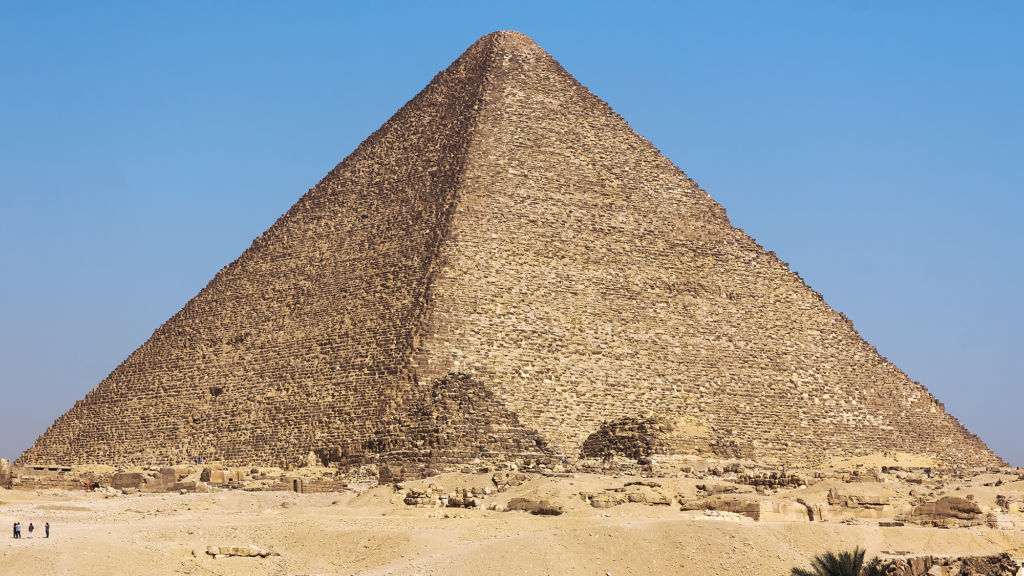
Figure 1: The Great Pyramid of Giza showing its massive scale against the desert landscape. Note the precision of the remaining casing stones at the base. (Source: Wikipedia)
What’s even more impressive: the base is level to within 2.1 centimeters (less than an inch), and the four sides differ in length by a maximum of just 4.4 centimeters (1.75 inches). On a structure covering 13 acres! This level of precision suggests sophisticated surveying and leveling techniques.
Ancient GD&T: Geometric dimensioning and tolerancing
GD&T is a language used in modern manufacturing to communicate permissible variations in a part’s shape, size, orientation, and location. Without such control, inaccuracies accumulate—resulting in, say, a leaning pyramid. The ancient Egyptians clearly understood this principle, even if they didn’t call it GD&T.
Their engineering toolkit included:
- The seked: A unit for measuring slope angles. Ancient Egyptian builders measured tangents of angles using the seked and the Egyptian level—a remarkably practical approach for ensuring consistent pyramid slopes.
- The royal cubit: A standardized unit of measure (approximately 52.4 centimeters or 20.6 inches) used throughout Egypt. The Great Pyramid’s dimensions are precise multiples of the royal cubit, suggesting centralized measurement standards.
- Set squares and plumb bobs: For ensuring perpendicularity and verticality. Archaeological evidence shows these tools were widely used.
- Water leveling: Some scholars hypothesize that the Egyptians used water-filled trenches to create a perfectly level reference plane for the pyramid base, though the exact method remains debated.
Dovetail joints and seismic design
Walking through the temples at Karnak and Luxor, I was struck by the sophisticated joinery techniques. The Egyptians created male-female dovetail joints in stone blocks—a technique that required extraordinary precision in cutting and placement. These joints locked stones together mechanically, not just through gravity and friction.
Even more fascinating: they used wooden keys (likely made of sycamore) within these joints to provide compliance during earthquakes. This is ancient seismic engineering! The wood could flex slightly, allowing the structure to absorb seismic energy without shattering the stone. Modern engineers use similar principles with expansion joints and flexible connections in earthquake-prone regions.
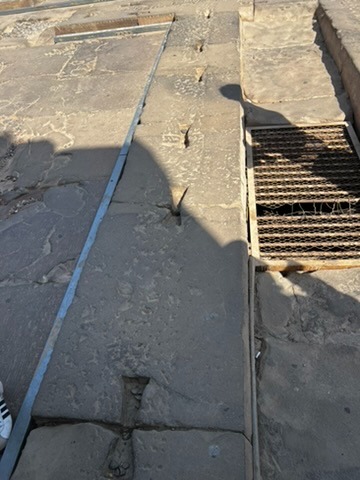
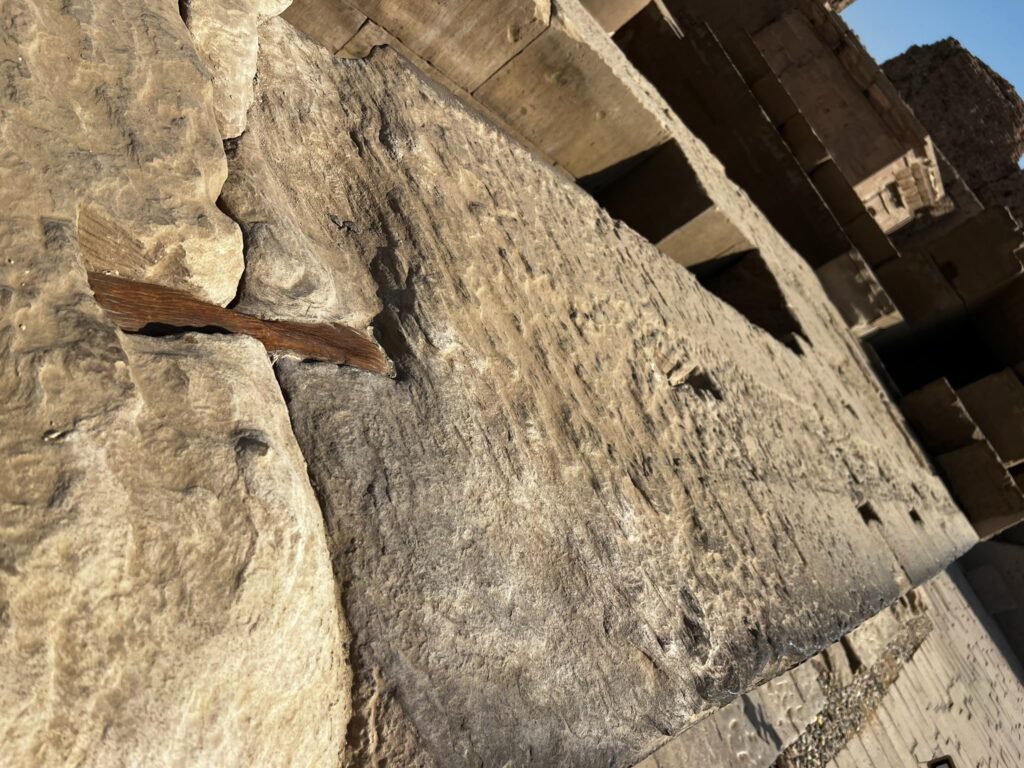
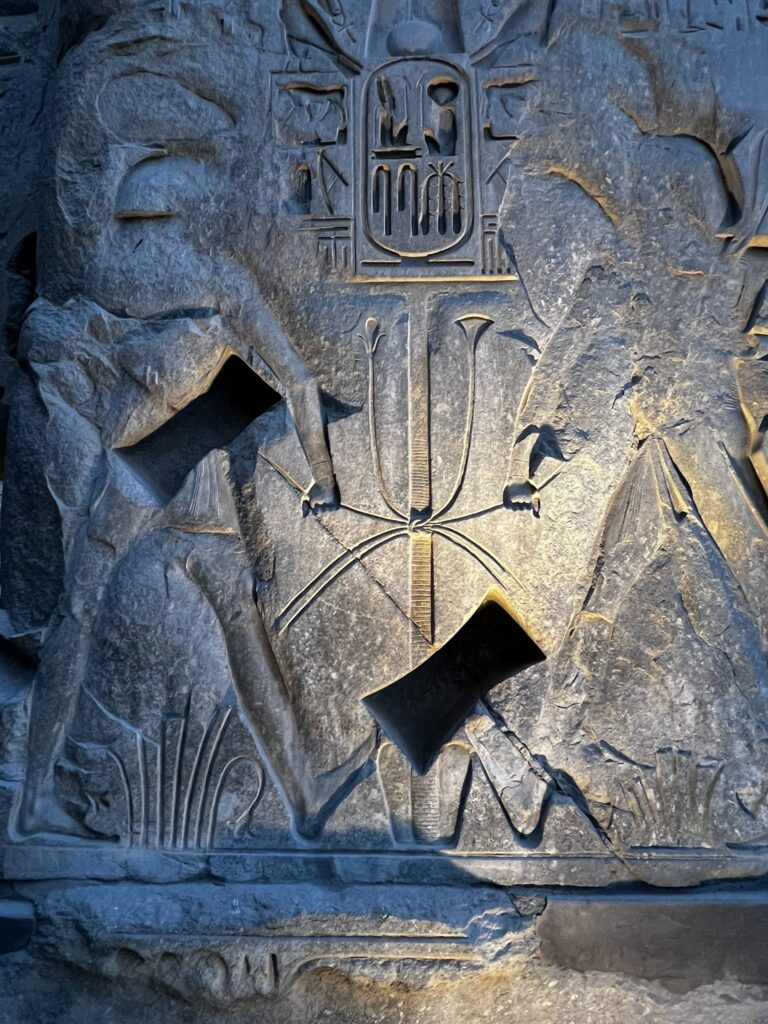
Figure 2: Close-up photographs showing dovetail joints as well as the use of wood (sycamore?) in these joints in the temple stonework at Karnak. Note the precision of the interlocking stone pieces. (Photo: Prasad Akella)
Keystones and the grid pattern
Egyptian builders frequently used grids of dissimilar-sized stones rather than uniform blocks. This isn’t random—it’s brilliant structural engineering. By varying stone sizes, they created a more robust, interlocking structure. The joints didn’t align vertically, preventing potential failure planes from propagating through the structure. Think of it as ancient masonry’s version of a running bond in brickwork.
At the tops of doorways and chambers, they placed keystones—central stones in arches that lock all other stones in place through compression. While the Egyptians didn’t invent the true arch (that credit goes to the Mesopotamians), they understood and used corbelled arches and lintel systems with great sophistication.
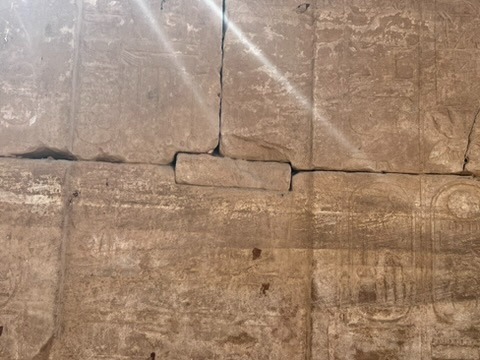
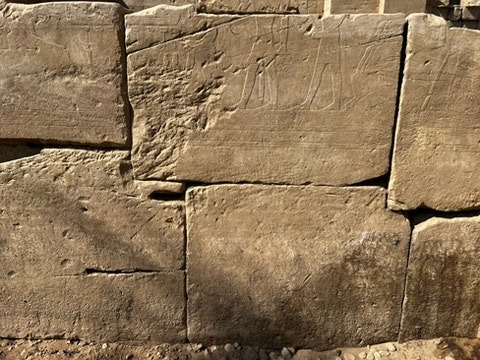
Figure 3: Keystones in temple stonework at Karnak. Note the use of the interlocking stone pieces. (Photo: Prasad Akella)
Consistent reliefs: The template system
The relief carvings covering Egyptian temple walls show remarkable consistency from top to bottom—figures maintain the same proportions whether they’re at ground level or 20 meters up. This wasn’t accidental. The Egyptians used a grid system for drawing reliefs before carving, ensuring consistent proportions.
Artisans would first draw the figures on smoothed stone using a standardized grid (typically 18 squares for a standing human figure). Only after approval would carvers begin the painstaking work of cutting away the surrounding stone. This separation of design and execution ensured quality control across massive surfaces.
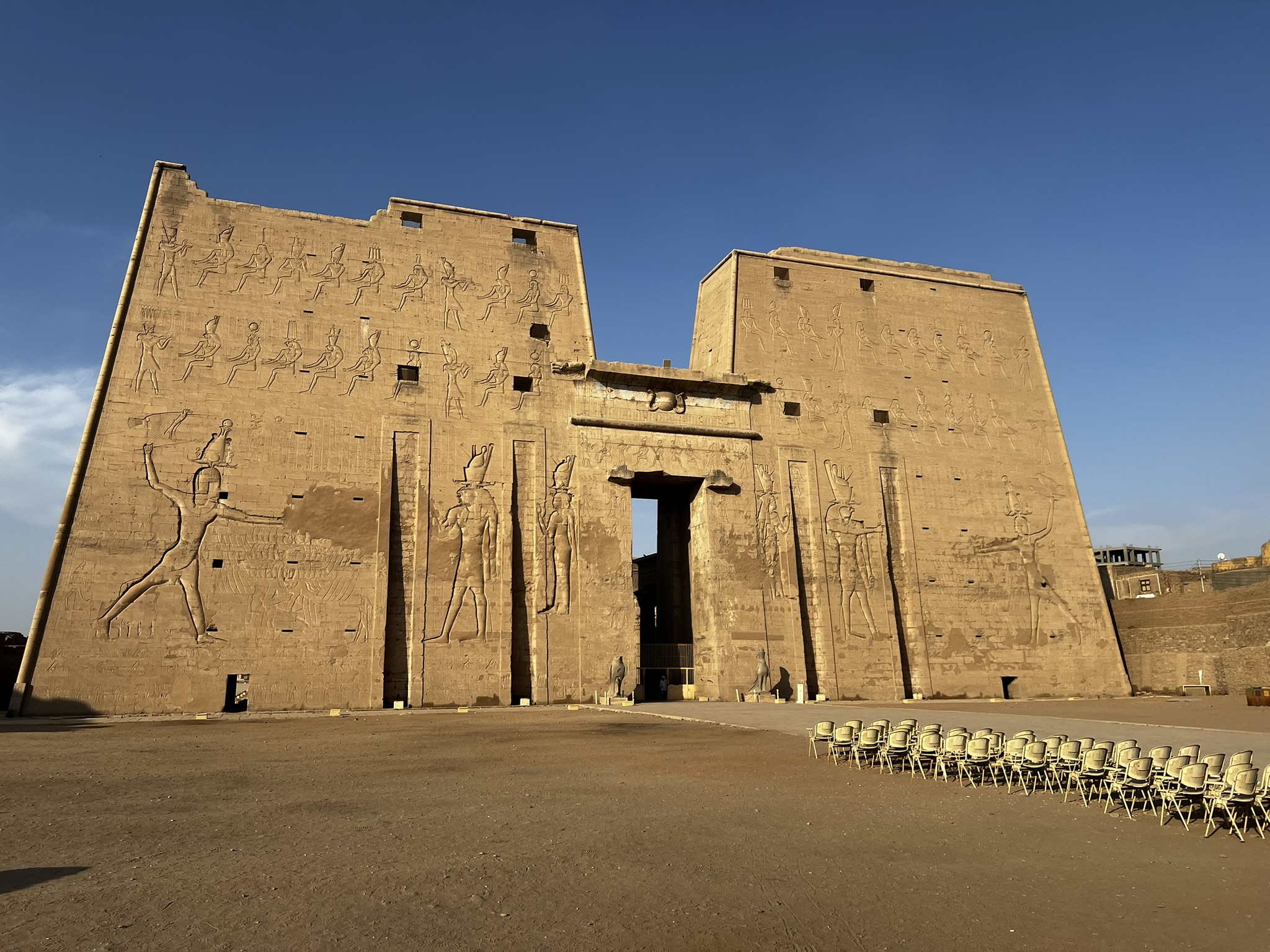
Figure 4: Temple wall showing relief carvings with visible grid lines still preserved in some areas, demonstrating the ancient drawing technique. (Source: Prasad Akella)
What they lacked: Perspective
Interestingly, as my daughter Pooja pointed out, ancient Egyptian art and architecture lack perspective as an engineering design concept. Egyptian relief carvings use a conceptual approach—showing objects from their most recognizable angle—rather than representing how they appear from a specific viewpoint.
Compare this to the Taj Mahal (built over 3,000 years later), where designers varied letter sizes on the building’s facade so they appear uniform from ground level. The letters higher up are larger to compensate for perspective foreshortening. This sophisticated understanding of perspective came much later in human history.
The Egyptians’ approach wasn’t a limitation—it was a deliberate aesthetic choice. Their art prioritized clarity and symbolism over optical illusion. But it does highlight an interesting gap in their otherwise comprehensive engineering knowledge.
Lighting design and astronomical precision
The lighting design in Egyptian temples demonstrates both practical engineering and symbolic sophistication. Architects carefully placed holes and slots in roofs and walls to illuminate specific statues or hieroglyphs at particular times. This wasn’t random—it created dramatic effects that emphasized the divine nature of pharaohs and gods. As sunlight streamed through these calculated openings, certain objects or people would radiate, impressing the masses with their supposed proximity to the divine.
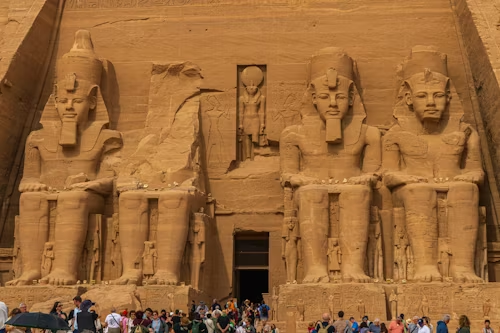
Abu Simbel represents the pinnacle of this astronomical engineering. Twice yearly, on February 22 and October 22 (originally February 21 and October 21—the alignment shifted by one day when the temple was relocated in 1968), sunlight penetrates 200 feet into the temple to illuminate statues of Ramesses II and three gods. A fourth statue, representing Ptah, the god of darkness, never receives sunlight—a deliberate design choice that has worked perfectly for over 3,200 years.
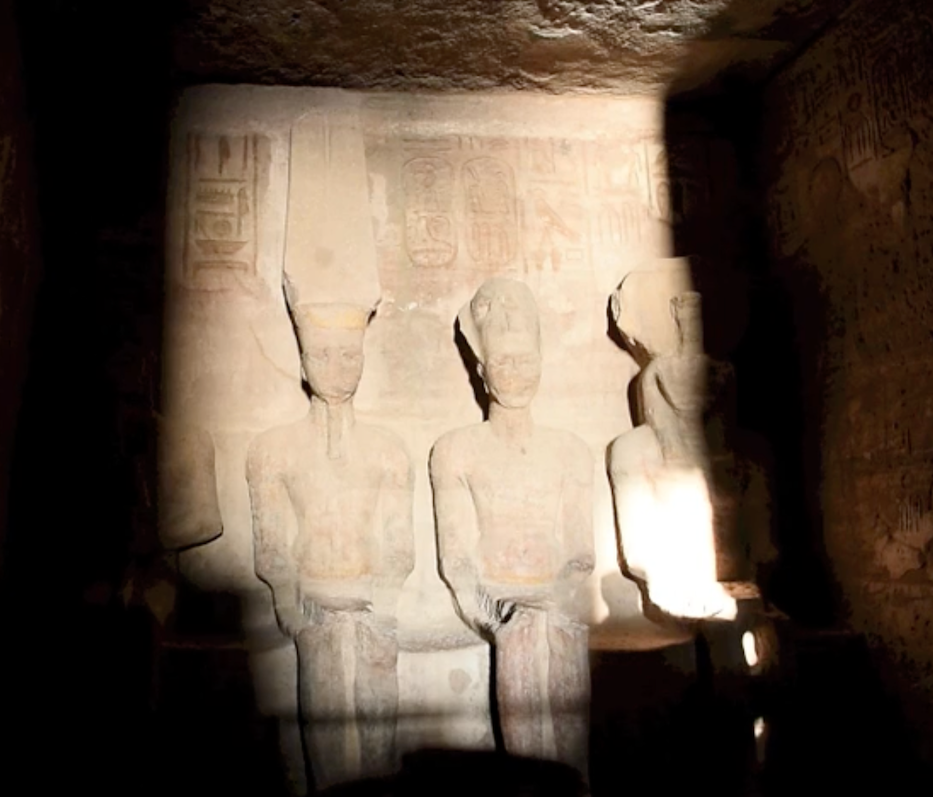
Figure 5: When the sun illuminates the statue of Ramesses II. (Source: Mr. Santorini’s video)
The Nileometer: Tax engineering
Perhaps the most practical piece of ancient Egyptian engineering I encountered was the Nileometer—a structure for measuring the Nile’s water level during the annual flood. These weren’t mere water gauges; they were sophisticated instruments for economic management.
The relationship between water level and taxation followed what economists would call a U-shaped curve. Too much water meant devastating floods and destroyed crops—minimal tax revenue. Normal water levels meant good harvests—maximum revenue. Too little water meant drought and poor harvests—again, minimal revenue. The Nileometer allowed administrators to predict agricultural output and adjust tax rates accordingly.
This is ancient data-driven governance! The Egyptians built multiple Nileometers along the river, creating a network of measurement stations that provided real-time information about the flood’s progress. Some Nileometers are still standing and functional today—a testament to their robust engineering.
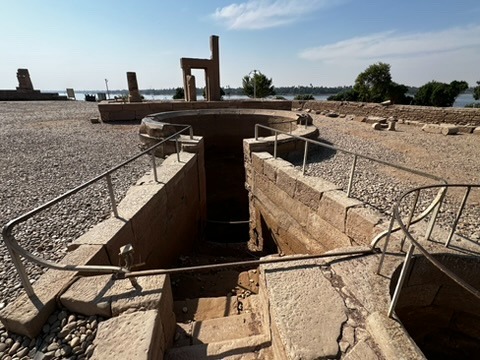
Figure 6: A Nileometer showing measurement markings on stone walls, used to gauge the Nile’s flood level and predict agricultural yields. (Source: Prasad Akella)
Modern engineering meets ancient: Moving Abu Simbel
The ultimate test of ancient Egyptian engineering quality came in 1968 when engineers had to relocate Abu Simbel to prevent flooding from the Aswan High Dam’s reservoir. This wasn’t a casual move—the entire temple complex had to be cut into blocks, moved 65 meters higher and 200 meters back from its original location, and reassembled with millimeter precision.
The international team of engineers marveled at the ancient construction. The blocks fit together so precisely that even after being cut apart and reassembled, the joints remained nearly invisible. The astronomical alignment—off by only one day after relocation—demonstrated the original builders’ extraordinary precision.
This $40 million UNESCO project (equivalent to about $300 million today) represented modern engineering’s respectful encounter with ancient mastery. The fact that 3,200-year-old structures could be successfully dismantled and rebuilt speaks volumes about the quality of the original construction.
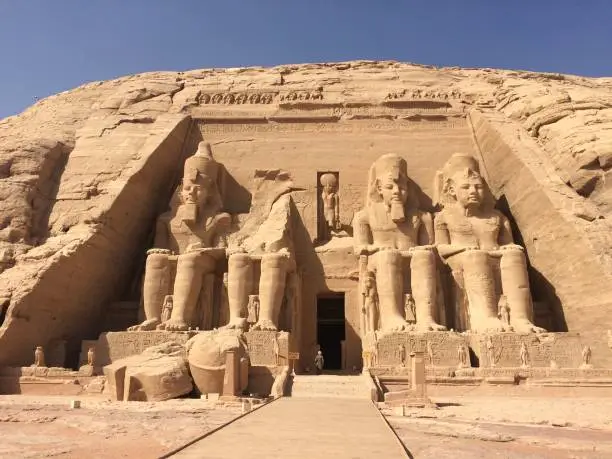
Figure 7: Moving Abu Simbel. (Source: iStock; Rick Steve’s video; UNESCO video; National Geographic video; Ancient Architects video)
How does it compare with modern standards?
Let’s put ancient Egyptian precision in a modern context. The Great Pyramid’s base, level to within 2.1 centimeters across 230 meters, represents an accuracy of about 0.009%. That’s equivalent to leveling a modern football field to within a quarter-inch—extraordinary even with modern laser levels.
The pyramid’s sides, oriented to the cardinal directions, are accurate to within 3.4 minutes of arc (about 0.06 degrees). Modern surveyors, with GPS and transits, aim for similar precision. The Egyptians achieved this using the stars—observing circumpolar stars and bisecting the angle between their rising and setting positions to find true north.
The fine limestone casing stones (most now removed, but visible at the pyramid’s base) were fitted so precisely that joints measure less than 0.5 millimeters. This rivals modern precision stonework and exceeds many contemporary construction practices.
The humility of 4,600 Years
Standing before these monuments, you realize that engineering excellence isn’t measured in computational power or sophisticated software—it’s measured in understanding principles, mastering materials, and executing with precision. The ancient Egyptians achieved extraordinary results not despite their technological limitations, but through deep understanding of mathematics, astronomy, materials science, and project management.
They couldn’t email blueprints or video conference with remote teams. They couldn’t run finite element analysis or simulate stress distributions. Yet they built structures that have stood for 4,600 years—longer than any modern building has existed, longer than most modern buildings are designed to last.
As an engineer who has worked with precision manufacturing and modern CAD systems, I left Egypt humbled. We have better tools, but the fundamental principles—precision, consistency, understanding materials, planning for the long term—haven’t changed.