There are moments in life that leave you slightly changed. Dallas, June 2026, was one of them.
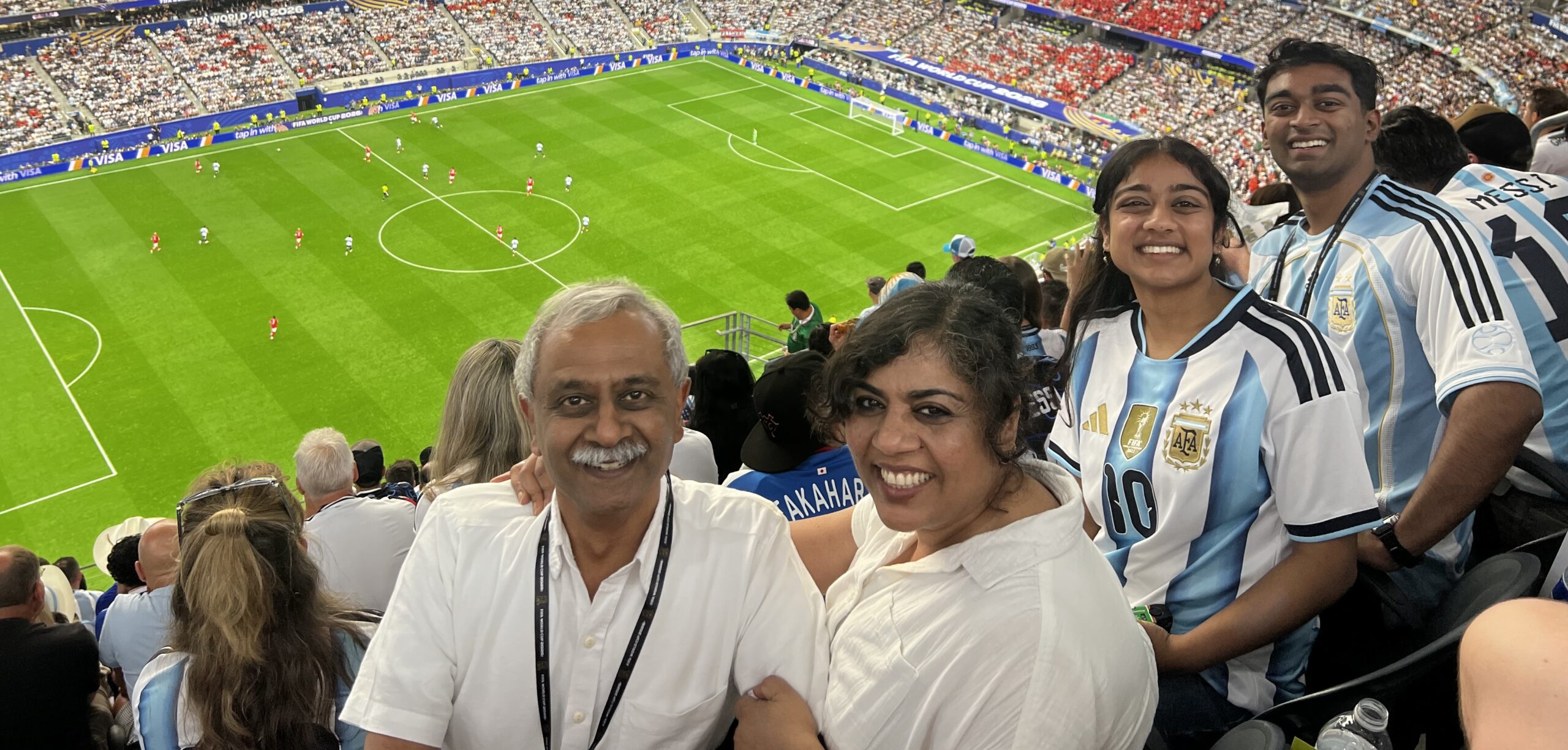
The four of us — Surekha, Chirag, Pooja, and I — found ourselves inside Dallas Stadium (aka, The Cowboys AT&T Stadium) for the Argentina-Austria FIFA World Cup group match. Every one of the 70,649 seats filled, the jumbotron told us. The sea of blue and white was staggering. Argentina jerseys as far as you could see, flags draped over railings and waving, scarves held aloft, people singing and dancing to the Argentine fight song “El que no salta es un inglés”. The noise before kickoff was already extraordinary. And then Messi (and team) walked out on to the field.
The decibel meters, the jumbotron again told us, hit 97dB. That number became meaningless the moment the crowd actually erupted. People were on their feet, jumping, grabbing strangers by the shoulders. The celebration was not in the crowd — it was the crowd. And when the first goal went in — Messi’s 17th World Cup goal, breaking Miroslav Klose’s all-time record, right there in front of us — I looked over at Surekha—one not given to public displays — and she was also jumping up and down, high-fiving the kids, grinning like she’d scored the goal herself.
The second goal, late in stoppage time, was something else entirely. A teammate spread his legs and let the ball roll through — a deliberate, selfless act — giving Messi the angle he needed, the team possibly the best chance it had, and Messi a shot at extending his record and at winning the Golden Boot award. The system was creating the moment for its master. Argentina 2, Austria 0.
Worth noting is what it took to get there: Messi arrived at this World Cup at 38 years old, and despite reportedly nursing a hamstring injury, opened the tournament with a hat trick against Algeria. He arrived in Dallas one goal away from a record, and left with two.
Sitting there in the noise and the light, I kept thinking: how did we get here? A geeky South Indian family from the Bay Area, not exactly known for its sporting pedigree. And yet, here we were.
The unlikely soccer family
It started in 2004, with Chirag.
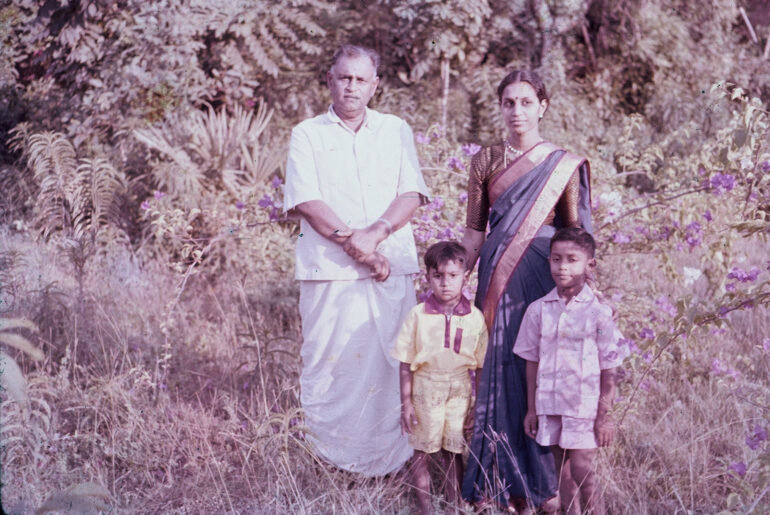
Our families — Surekha’s and mine — were not athletic households. A brother on each side who played cricket or swam was the outlier, not the rule. Engineering, biotech, law, academics: that was the script. Soccer was emphatically not on it.
But Chirag showed something early. His first coach — a young, quiet, South American — pulled me aside at the end of his first training camp and said it simply, almost in passing: this kid has something in him. I nodded politely, the way a parent does when they’re not sure whether to believe it. I’ve thought about that moment many times since. A good coach sees past the crowd. He was looking at a six-year-old and seeing something the rest of us hadn’t noticed yet.
Then came Pooja. While she insisted on being at all of Chirag’s games, she resisted the field entirely until 3rd or 4th grade, when she announced, with the quiet certainty that is entirely her personality, that she wanted to play. Her coach came up to me after the first few sessions, genuinely puzzled. “Didn’t you say she hasn’t played before? Because her sense of the game is incredible for her age.” Two different kids, two different paths onto the same field — and both of them found by someone who was paying attention.
Surekha deserves her own paragraph here. She is the quiet engine of everything this family did on weekends. The warm Bay Area days. The trips to blistering Davis. The logistics of schedules, carpools, snacks, and the relentless cheerfulness required of a soccer mom who had not exactly signed up for a decade of this. She handled all of it with aplomb — which is a word that exists specifically to describe Surekha on a soccer sideline. Somewhere along the way, deciding that watching from the sideline wasn’t enough fun, I got my AYSO referee certification and stepped onto the field alongside both kids. We all had something in common. Soccer became a part of our lives.
How we got to Dallas: Two stories
The World Cup coming to the United States created a ticket lottery. Chirag mobilized the family. Aunts, uncles, cousins across the extended family: everyone applied. When his aunt won, Chirag got on the phone and built a plan. First objective: ensure that every family member who wanted to attend a match could do so. Second objective: use the secondary market on surplus tickets to offset the cost of the whole endeavor, so the economics could work for everyone. (Aside: Not surprisingly, he had spent a summer working on secondary sales at TicketMaster.)
For an academic family that came to this country carrying textbooks rather than playbooks, what followed was slightly surreal. We were watching matches in Houston, Dallas, Santa Clara, and Seattle. The family that once debated whether soccer was worth a Saturday morning was now debating which city to fly to next. Was commenting on games. The transformation is so complete, in fact, that the family is now seriously considering doing something similar for the upcoming Olympics. A sea change, if there ever was one.
Our nephew Ananya, based in Delhi, deserves his own moment here. He has attended the last three World Cups. This time, a combination of work and the geo-politics of today’s world kept him home. He graciously passed his tickets to us. He is the reason we were in Dallas. Thanks, Ananya!
What the soccer field teaches you and the kids
A dozen years of weekend soccer teaches you things that have nothing to do with soccer.
From bunchball to chess. In year one, every kid swarms the ball — a rolling scrum of cleats and good intentions. By year four or five, something clicks. They start reading space. They hold their positions. They trust that a teammate will cover. What you’re watching is not just physical development. It’s the beginning of systems thinking. They’re learning to think past themselves — to understand that the team is a structure, not just a collection of individuals running in the same direction.
Chirag and the parents (Chirag and) Pooja played on teams where the parents represented the Valley — VCs, executives, lawyers, engineers. What I noticed, over time, was that these folks sought out Chirag. They’d pull him aside to get his read on whatever sport was in season that week — soccer, football, basketball, tennis, it didn’t matter. Chirag would articulate a view, defend it when challenged, adjust when the argument required it. They’d revisit the calls at the next weekend’s game. Rinse and repeat. Beyond boning up on sports stats, he was building the confidence that comes from having, owning and defending a perspective.
Pooja and the center back. The center back is the last field player between her goalkeeper and the opposing team and the anchor of the defence. Not a glamorous position. The goal scorers get the celebrations; the center back gets the quiet satisfaction of nothing getting through and pressure of being exposed every time the ball does get through to the goal. Pooja slowly built a reputation of being “the wall” with her teammates, coaches, and parents. She learned to own her position.
The coaches
Over the years, three coaches stand out.
Laura ran weekly awards — not for goals, but for behaviors she wanted them to learn. Hustle. Encouragement. Helping a teammate get up. Passing using the left foot. Smart kids, which these were, notice quickly what gets celebrated. They calibrate. It’s a simple and devastatingly effective management technique that most organizations never figure out.
Jim had absolute calm. During matches, regardless of the scores, regardless of the referee’s calls, regardless of what the other team’s parents were shouting from the opposite sideline — Jim was steady. Composure is contagious. So is panic. A coach who never loses it teaches his players that difficult situations are manageable. They internalize that, and carry it.
Tony experimented. Formations changed. Roles rotated. He’d take the team off the field entirely for activities designed to build cohesion rather than skill. He treated the kids as learners — which they were — rather than as a product to be optimized toward a winning record.
The thread connecting all three (and the other numerous unnamed coaches who stepped in to coach these kids) was something one of them said to me that I’ve never forgotten: “We have smart kids. You don’t bully them. You restate things, you celebrate behaviors, you build a camaraderie, you let them play on the field to show you trust them.” The distillation of a complete philosophy of good leadership.
Resilience, roles, and hard choices
Chirag’s teams often got pounded. Week after week, the scoreline was not kind. And week after week, they went back. The love of the game was stronger than the scoreline. They learned to find the lesson inside the loss — to optimize, to adjust, to show up the following Saturday with something approaching hope. It was an extraordinary thing to watch. Losing, it turns out, is one of the more important things the field teaches — if the coach is good enough, and the kids are resilient enough, to let it be a teacher rather than just a wound.
Pooja’s teams were, on average, more successful; which meant that when they lost, the landing was harder. The lesson there was different but equally valuable: there are better teams. There always will be. Learning to handle that without excuses is its own form of growth.
Then came high school, which accelerates everything. Your classmates are mature and exploring options. College applications loom. Free time vanishes. Where do you focus?
Chirag’s team fell apart suddenly in 10th grade. Several players had college soccer ambitions. The team was improving, but not fast enough to serve those goals. And so it dissolved — suddenly, somewhat catastrophically, leaving kids who had grown up together standing on the sideline wondering what happened. They were shocked. Then they learned to move forward. That, too, is a lesson.
Pooja faced a different version of the same cliff. Her coach believed she could play college soccer. But her heart was in dance, which she was also good at. And there were not enough hours in the day for both. At fifteen, she sat with her soccer coach and her dance teacher and chose. It wasn’t easy for the fifteen-year-old to know herself clearly enough to make a hard call and act on it. That’s the field paying out in a currency that has nothing to do with goals shot or blocked.
The role of the parents evolves too. You start by cheering for your kid. Then you realize not every kid scores goals — roles exist, and your job is to support the role and the team, not just your child. Further along, you realize your kid may not be the anointed one. That lesson belongs as much to the parent as to the child. The village doesn’t assemble itself.
From the field to the boardroom
Watching Laura, Jim, and Tony across those years on Bay Area fields, I kept having a nagging sense of familiarity. I’ve seen this before, I kept thinking. Not in cleats — in conference rooms, startup off-sites, and board meetings. The principles turn out to be identical. Only the uniforms change.
On Messi and Ronaldo — the team player and the soloist. Argentina builds its entire system around Messi — every pass structure, every formation decision, exists to give him one clear moment near the penalty area. In Dallas, a teammate literally spread his legs to let the ball through to Messi, so he could shoot the second goal. The system creates the goal. The superstar and the team are not in tension; they are in service of each other.
Contrast that with Cristiano Ronaldo at this same World Cup. Thierry Henry — not exactly an unqualified observer — put it plainly during his gametime comments after watching Ronaldo snatch at a chance when a teammate was in a better position: “The team needs to score, not you need to score.”
Two generational talents. Two completely different answers to the question of what the game is for. In any company, you will recognize both types immediately. One makes everyone around him better. The other turns everyone around him into a supporting cast in a story that has only one protagonist. You want the first. You cannot afford the second — regardless of the talent.
On the bad apple. Bob Sutton’s No Asshole Rule is required reading for anyone who has ever managed a team and told themselves that the difficult person’s performance justifies the cost. It does not. The damage is never contained to the direct victim. It radiates. One player who won’t pass, blames teammates, and pouts when substituted can unravel something that took two seasons to build. As I learned the hard way, act early, or spend the season managing the rot.
The sideline as a social network. The soccer field gave us something I did not anticipate: friendships. Not the intense, forged-in-startup-fire kind. The ones that form slowly, over shared Saturday mornings, over a common language of games and kids and seasons.
Mark Granovetter — Stanford sociologist, and someone I had the privilege of working with at Spoke — spent his career studying what he called the strength of weak ties. The core insight is counterintuitive: it is not your close relationships that generate the most unexpected opportunity. It’s the peripheral ones. They move in different circles, carry different information, and reach into different worlds on your behalf. At Spoke, we built an enterprise around exactly this — mapping the implicit social graph of an organization to surface the warm introductions that no org chart would ever reveal.
Soccer fields are extraordinary places to build that kind of network. Nobody is performing. Nobody is pitching. Engineers and investors and executives and teachers, all leveled by the same anxious hope that their kid’s team holds the lead. Those connections surface in ways nobody plans — a call about a role, a door opened from a direction you weren’t watching, funding for a company you are putting together.
(Smoking is another activity that cuts across socio-economic strata to create similar, unexpected networks.)
On teams that have played together. As I have observed across twenty years of watching startups form — and as Noam Wasserman confirmed with data from nearly ten thousand founding teams in The Founder’s Dilemmas — prior shared work experience is the single strongest predictor of founding team stability. Not friendship. Not family. Work. Teams of prior coworkers are significantly more stable than teams built on social relationships alone, because friendship without professional history leaves the hard conversations unresolved. A team in its third soccer season together has already had those conversations — about roles, about ego, about who does what when the game is on the line.
The New York Knicks just demonstrated this at the highest level. Jalen Brunson, Josh Hart, and Mikal Bridges won an NCAA championship together at Villanova before reuniting in New York. Brunson left a reported $113 million on the table so the Knicks could build a competitive roster around him. His explanation: “This is just me wanting to do my part to help this team try and get one.” The Knicks ended a 53-year championship drought. Brunson was named Finals MVP.
On Bill Campbell — the trillion dollar coach. Few figures in Silicon Valley were as quietly influential as Bill Campbell — football coach turned tech mentor to Steve Jobs, Larry Page, and Eric Schmidt, among dozens of others. Team-first, always. He gave tough feedback when egos crept into decision-making. And he watched, in every room he entered, for one simple signal: did people say “I” or “we”? Did they get excited about other people’s successes? Were they willing to make concessions for the overall benefit of the team?
That is, almost word for word, what Chirag’s first coach was doing on a Bay Area soccer field — investing in someone else’s growth without any direct benefit to himself.
The CEO who micromanages is the coach who runs onto the pitch during play. She has confused her role. Her job is the formation, the game plan, the culture — and then to trust the team she built to execute it. If there is a bad apple, she acts quickly and with dignity. If the mission is clear and the roles are owned, she gets out of the way.
Back to Dallas
Nearly an hour after the final whistle, Argentina fans were still cheering and chanting in the stands. I don’t think any of us were in a hurry to leave either.
What we saw in Dallas wasn’t just sport. It was twenty years of a family’s journey arriving at a single afternoon in Texas — a journey that started with a quiet South American coach pulling a father aside and saying this 5 year old kid has something in him, and ended with that kid, now 26, engineering the logistics that got his whole family there. (Not to mention, spending his birthday — watching a game with his childhood and college friends!)
Messi, at 38, with a hamstring that had no business being on a World Cup pitch, still breaking records. Still making his teammates better. Still, in the most literal sense, showing up.
That’s character. And it turns out — on soccer fields in the Bay Area and Davis, in startup conference rooms across Silicon Valley, and on a Tuesday afternoon in Dallas — that’s the only thing that really compounds over time.
The family is thinking about the Olympics. Chirag, presumably, will get to it when the World Cup ends!
—–
This article has been shaped, in part, by the many articles on the role of sports coaches in the business world that my brother, Srinivas, has shared with me over the years. Including introducing me to Bill Campbell — the trillion dollar coach. Not surprising since he was the most athletic among us siblings and given his intellectual bent of mind.