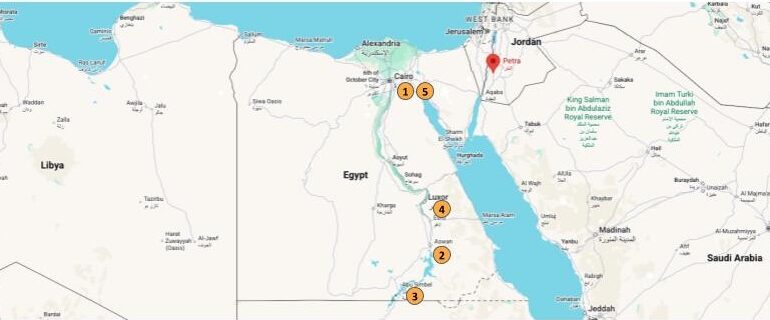
Egypt assaults your historical, visual, physical, and aural senses as few other countries can. But it also challenges your patience in ways that are equally intense. Within minutes of arrival, you encounter both the sublime and the transactional—ancient wonders that inspire awe alongside modern hustles that inspire exhaustion.
Seeing, touching, and understanding what the ancient Egyptians accomplished in 3,500 BC is humbling. Despite coming from India, where we think of history as thousands of years old, Egypt was at least an order of magnitude more impressive. Yes, India had the Indus Valley civilization; but not much remains for us to see and touch.
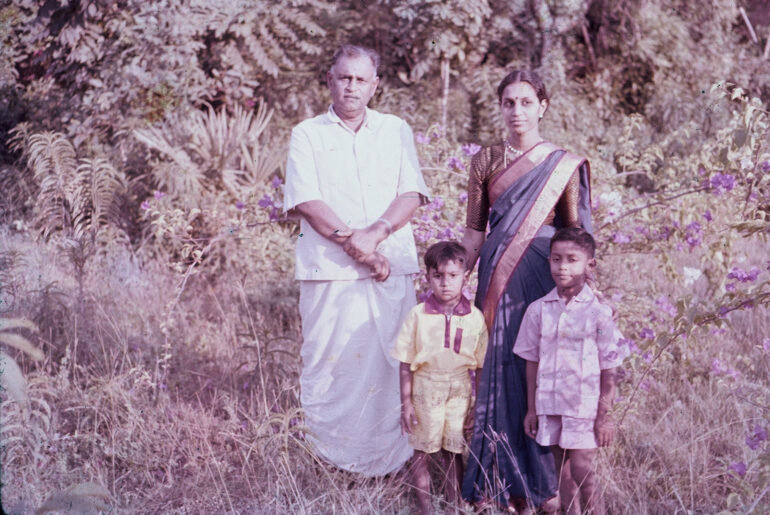
Years ago, back in 1969 and thanks to my father, I chanced upon a National Geographic article on the re-siting of the Abu Simbel temple as Aswan dam and Lake Nasser were being created. It is thanks to this chance encounter that my interest in Egypt was piqued. Similarly, Surekha’s interest was piqued by her mother, who—as her geography teacher—taught her about Egypt! Not surprisingly, Pooja, Chirag, Surekha and I were excited to be traipsing around the country.

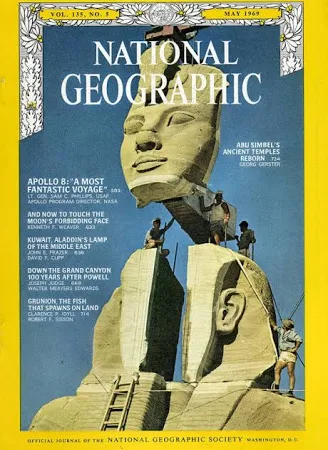
(Source: National Geographic, May 1969)
A historical, cultural, and archaeological perspective
Studying a satellite map of Egypt, one immediately understands how a combination of water, fertile soil brought down from the Sudan highlands, and warm weather triggered the growth of the Egyptian civilization. The Nile threads its way down from Sudan in the south and empties itself into the Mediterranean. And in so doing, has sustained life for these 5,500 years. Go a few miles east or west of the river and one is in the harsh desert!

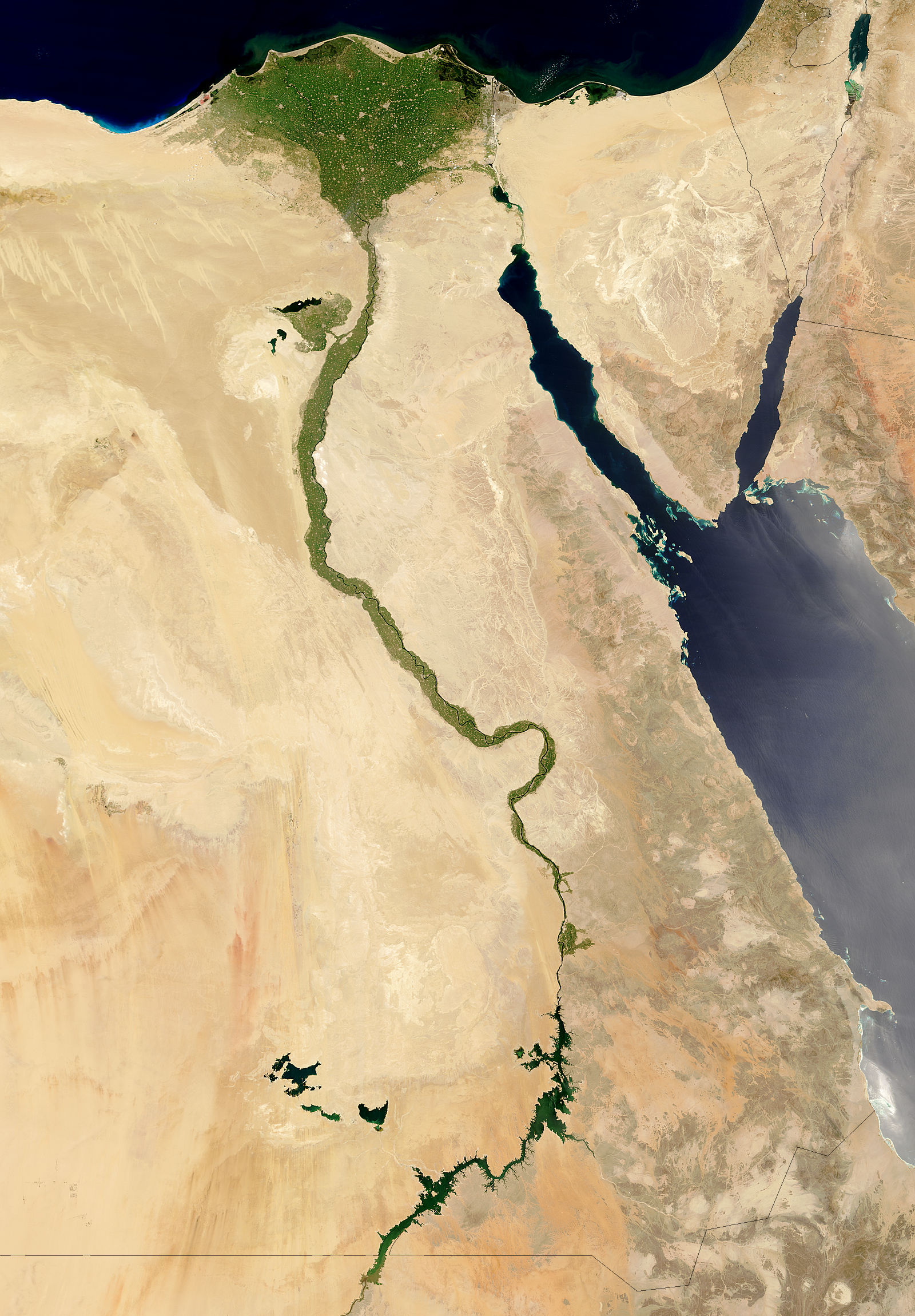
The centrality of the Nile in the world of the ancient Egyptians is obvious when one sees that the Egyptian calendar was built around a three season annual cycle—all tied to the Nile’s cycle: Akhet (flooding), Peret (planting), and Shemu (harvesting). This agricultural calendar defined not just farming but the entire civilization’s rhythm for millennia.
The pantheon of gods and pharaohs wanting to be treated as gods
Egypt once boasted of a pantheon of 2,800 gods. So many that even my Indian mythology training couldn’t help me but gasp for air as we made our way through Egypt’s myriad temples—testaments to ancient Egypt’s religious fervor—including Philae, Abu Simbel, Kom Ombo, Edfu, Luxor, and Karnak. These weren’t merely buildings; they were cosmological statements in stone, embodying the relationship among the gods, pharaohs, the Egyptian people, and the solar system.
The Karnak Temple complex, constructed over 2,000 years by approximately 30 pharaohs, is the largest religious building ever constructed. Its famous Hypostyle Hall alone spans 50,000 square feet, filled with 134 massive stone columns, the twelve center columns reaching 70 feet tall. Walking through this forest of columns, I felt dwarfed—precisely the effect ancient architects intended.

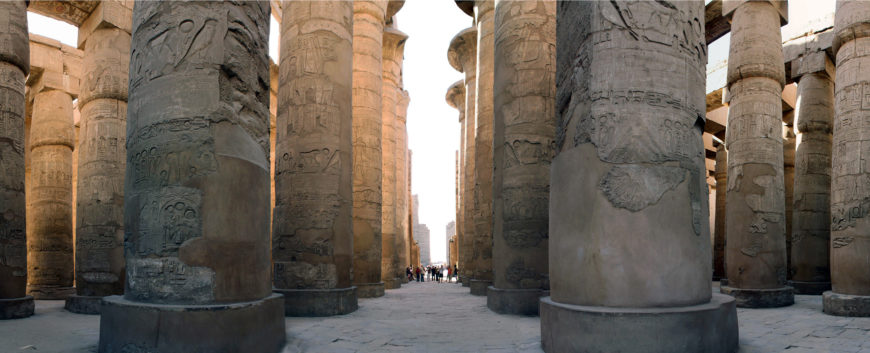
About 1.5 miles south, the Luxor Temple served a different purpose. Built primarily during the New Kingdom (~1400 BCE), this temple was dedicated to the rejuvenation of kingship. Unlike other temples dedicated to specific deities, Luxor focused on the divine essence of pharaonic power itself.
The two temples are connected by the Avenue of Sphinxes—a 1.7-mile walkway lined with approximately 1,350 ram-headed sphinx statues. This sacred avenue served as the ceremonial route for the annual Opet Festival, where priests carried golden boats containing statues of gods from Karnak to Luxor, accompanied by musicians, dancers, and cheering crowds. Upon reaching Luxor Temple, the pharaoh underwent ritual purification and symbolic rebirth that renewed his royal “ka” (life force) through communion with the gods, demonstrating that pharaonic power flowed not from conquest but from divine authority itself—making the Avenue of Sphinxes a physical bridge between heaven and earth.
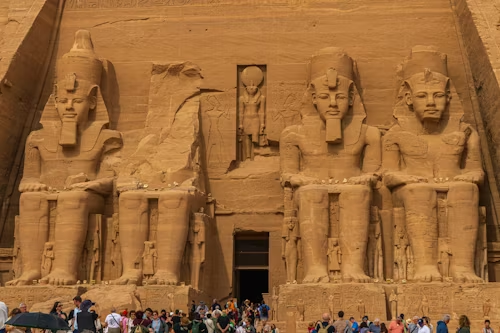
Perhaps most spectacular is Abu Simbel, the massive rock-cut temple built by Ramesses II between 1264 and 1244 BCE. Four 66-foot-tall statues of Ramesses guard its entrance, their stern faces conveying power to anyone approaching Egypt’s southern boundary. Twice a year, on February 22 and October 22, sunlight used to penetrate 200 feet into the temple to illuminate statues of Ramesses and three gods—a feat of astronomical and engineering precision that still astounds.
Officially, the Abu Simbel temple is a temple of the gods Ra, Ptah and Amon/Amun. But, in reality, it was a projection of Egypt’s military strength by Ramesses II onto tribes in Sudan whom he had subdued during his 67-year reign. But, the more interesting side story is that the temple is Ramesses’s attempt to become a God in the eyes of his people. The large statues at the temple are of him, not the gods. The light that penetrates 200 feet into the building highlights him and Ra as well as Amun, not the God Ptah sitting immediately beside him! As it turns out, Ptah was an important god—the god of creation and the underworld and eternal darkness. By bathing himself and Ra and Amun in light, Ramesses II was elevating himself to the highest tier of gods, the sun gods.
An obsession with the afterlife
The ancient Egyptians were obsessed with the afterlife, viewing death as a transition rather than an end—an opportunity for rebirth and eternal happiness. They believed the afterlife mirrored life itself: same situation, people, land, job. The elaborate preparation in tombs and pyramids was essential because reaching the afterlife wasn’t automatic.
Like Christians answering to St Peter, the departing soul had to pass judgment by the Egyptian gods and navigate the challenging underworld. Body preservation was critical to ensure Ka—the vital essence of life—would be available in the afterlife. Most importantly, you had to avoid a second death should your heart weigh more than a feather.
The pyramids and Valley of the Kings tombs were designed to ensure Pharaohs reached and enjoyed a long afterlife. As King Tutankhamun’s tomb revealed, all worldly assets were left with the body in the tomb for use in the next life.
Dynasties and divine rulers
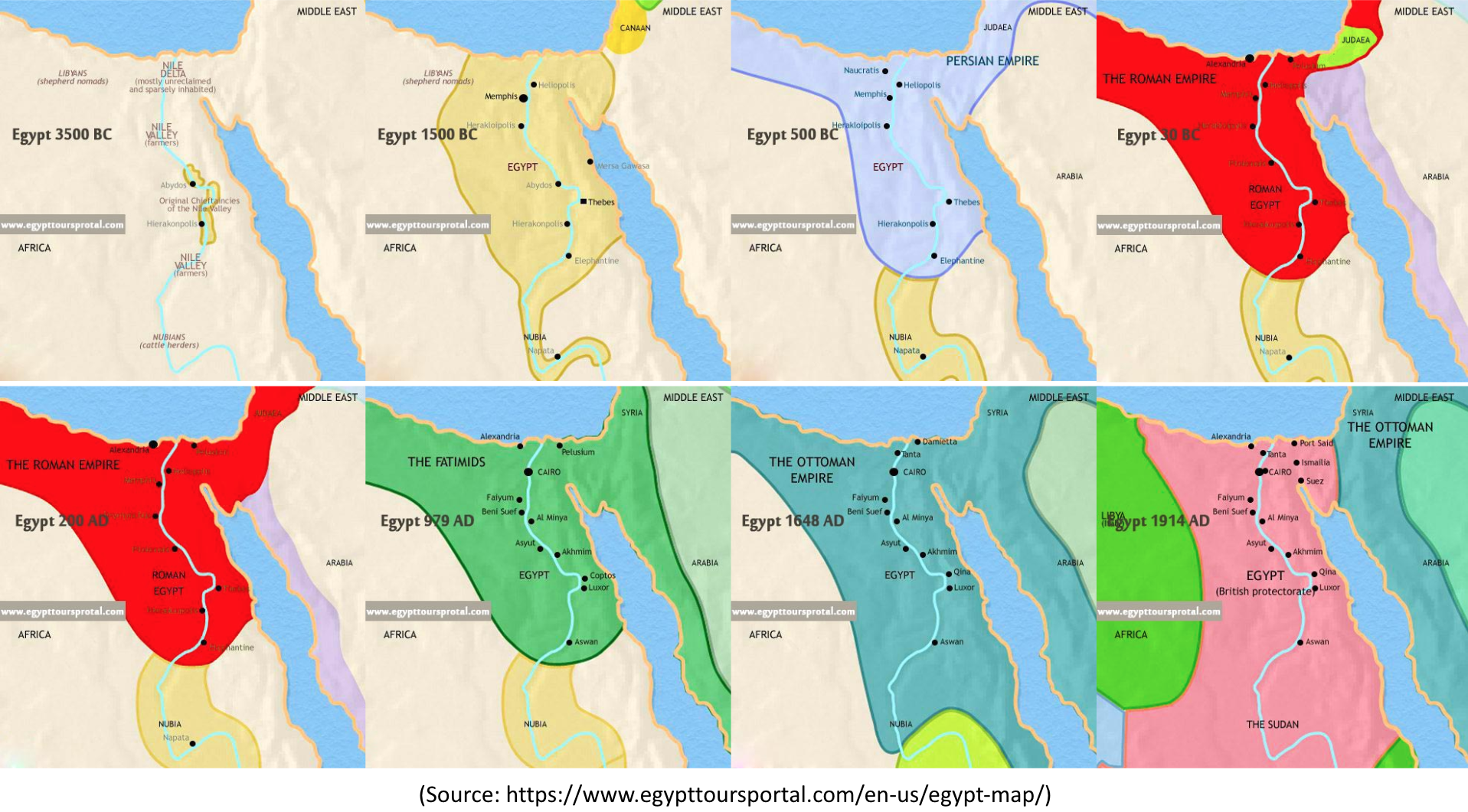
Egypt’s history spans approximately 30 documented dynasties plus the Ptolemaic and Roman periods, covering over 3,000 years of civilization. The pharaohs weren’t merely rulers; they were considered living gods, intermediaries between the divine and mortal realms—a notion that is seen repeatedly in everything from the architecture of the pyramids to that of the Grand Egyptian Museum.
The ‘mega pharaohs’ left indelible marks: Khufu built the Great Pyramid around 2560 BCE; Hatshepsut, one of Egypt’s most successful female pharaohs, ruled during the 18th Dynasty (c. 1479-1458 BCE) and commissioned magnificent monuments including her mortuary temple at Deir el-Bahari; and Ramesses II, who reigned for 66 years (1279-1213 BCE), plastered his name across monuments throughout Egypt.
Interestingly, royal incest was the norm—pharaohs frequently married their sisters or half-sisters to keep the divine bloodline pure. When foreign dynasties conquered Egypt (the Nubians, Persians, Greeks, and Romans), they adopted Egyptian customs, hieroglyphs, and even the title of pharaoh to legitimize their rule to Egyptian subjects.

Hieroglyphs, language, and rewriting history
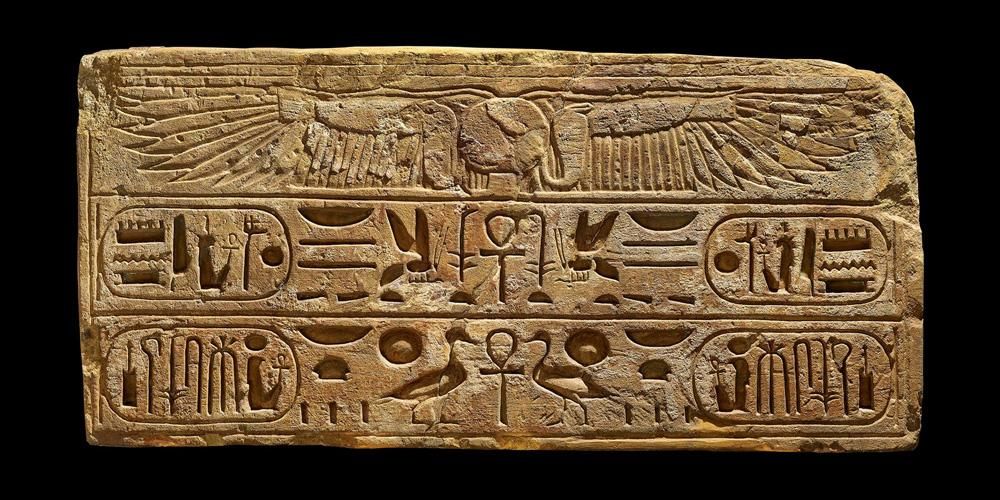
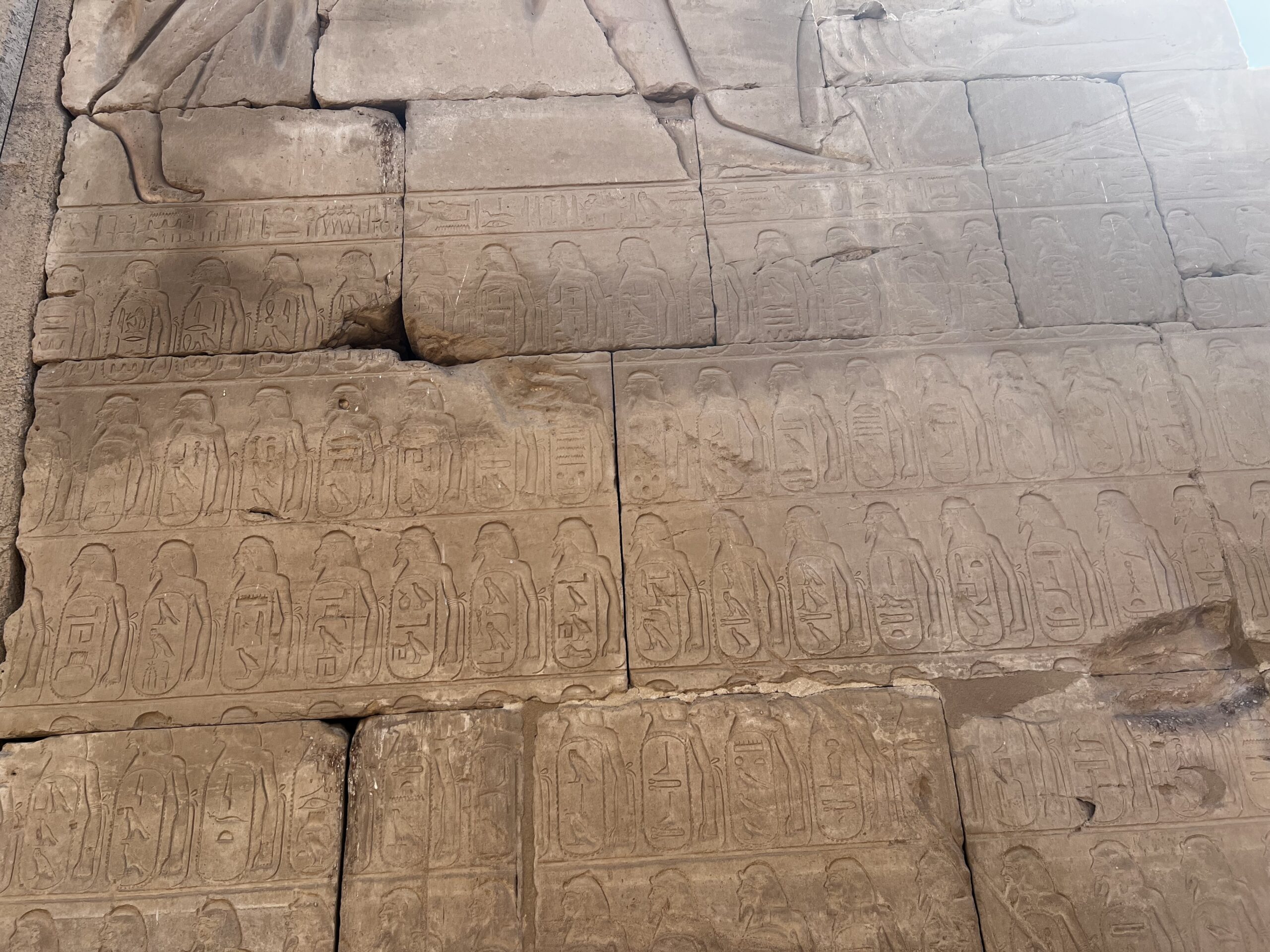
Ancient Egyptian hieroglyphs—those mysterious symbols covering temple walls—remained undecipherable for centuries until the discovery of the Rosetta Stone in 1799. This granodiorite stele (“public announcement carved in granite”), inscribed in 196 BC on behalf of the Ptolemaic King Ptolemy V in three scripts (hieroglyphic, Demotic, and Greek), allowed Jean-François Champollion to crack the code in 1822.
Each wave of conquerors transformed the written and spoken language. The Greeks introduced the Greek language alongside hieroglyphs. The Romans brought Latin. The Islamists introduced Arabic, which remains Egypt’s official language today.
Pharaohs routinely rewrote history, literally. Ramesses II exemplified this practice, carving his name into monuments built by his predecessors. As the saying goes, the victor gets to write history—and in Egypt, they literally chiseled it into stone.

The scientific legacy: When practical genius met divine ambition
Standing in the corridor at the back of Kom Ombo Temple was an entire wall depicts surgical instruments from 180-30 BCE—scalpels, forceps, bone saws, dental tools—remarkably similar to what you’d find in a modern surgical kit. This wasn’t just a temple; it was a renowned medical center where pilgrims sought healing from Haroeris, the falcon god of physicians.
The ancient Egyptians understood anatomy, performed complex surgeries, set fractures with splints, cauterized wounds, and used honey as an antiseptic—a practice modern medicine has validated thousands of years later. They had even figured out the role of sperm in reproduction! The Edwin Smith Papyrus (circa 1600 BCE) is the world’s oldest surviving surgical treatise, detailing trauma management and wound care with almost modern sophistication. Egyptian medical science was clearly advanced.
Mathematics: The language of monuments
The mathematical prowess of ancient Egypt is equally astounding. These weren’t theoretical mathematicians—they were practical problem-solvers who developed mathematics to measure fields after floods, calculate taxes, and design monuments that have stood for 4,500 years.
Ancient papyri reveal a sophisticated understanding of arithmetic, geometry, and early algebra. The Egyptians used a base-10 system, understood fractions, and could calculate areas and volumes—precisely what they needed for their construction projects. The concept of seked (slope measurement) was essentially early trigonometry, ensuring that distinctive 51-52 degree pyramid angle.
Astronomy: Reading the heavens
The Egyptians were masterful astronomers. They aligned pyramids and temples to cardinal directions with accuracy that modern surveyors find difficult to replicate. The Great Pyramid is aligned to true north with an error of only 3/60ths of a degree. The air shafts in the King’s and Queen’s chambers point precisely toward Orion’s Belt, stars that held tremendous religious significance in Egyptian cosmology.
The most spectacular demonstration of astronomical precision is at Abu Simbel. Twice a year, on February 22 and October 22 (marking Ramesses II’s birthday and coronation), sunlight penetrates exactly 200 feet into the temple’s inner sanctuary to illuminate the statues of Ramesses II, Ra-Horakhty, and Amun-Ra, while leaving Ptah (the god of darkness) in shadow. This required complex calculations involving the sun’s seasonal positions, the temple’s precise orientation, and architectural design that could channel light with laser-like precision through multiple chambers. When UNESCO relocated the entire temple in the 1960s to save it from Lake Nasser, engineers struggled to maintain this alignment—and were off by one day.
Engineering: Moving mountains, literally
The engineering achievements ultimately take your breath away. The Great Pyramid, built around 2560 BCE, consists of approximately 2.3 million stone blocks, the largest weighing 80 tons and transported from Aswan, 500 miles away.
How did they do it? The best answer I can find is that no one is entirely sure. The prevailing theories involve ramps, levers, sledges, and tens of thousands of workers over 20+ years. But what we know with certainty: structures built with precision that modern laser levels confirm as extraordinary.
At Karnak, those 134 massive columns—the central ones reaching 70 feet tall—were carved from single stones, transported, lifted, and covered with intricate hieroglyphs. The logistics boggle the mind.
Most impressive? The ancient Egyptians achieved all this without iron tools, without wheels for transportation, and without pulleys. As Herodotus acknowledged, the Greeks owed much to Egypt. Pythagoras and other Greek scholars studied in Egyptian temples, bringing knowledge back that would seed Western mathematics and science.
More to come on ancient Egyptian engineering skills in Section Two of the Egypt series!
The integration of science and divine purpose
What strikes me most about Egyptian science is how inseparable it was from their religious and practical worldview. (Perhaps, this is true of most civilizations?) The same mathematical precision that enabled them to measure fields after floods also allowed them to encode cosmic principles into their monuments. The astronomical knowledge that helped them track seasons and create accurate calendars also manifested in temples where sunlight performed sacred rituals twice a year for millennia. The medical knowledge that treated patients in temple hospitals was intertwined with religious healing and divine intervention.
The ancient Egyptians didn’t compartmentalize knowledge the way we do today. For them, mathematics, astronomy, medicine, and engineering were all expressions of ma’at—the cosmic order that permeated everything. Understanding and working with this order, whether calculating pyramid volumes or treating wounds, was simultaneously practical, intellectual, and sacred.
Standing before these monuments, touching stones carved with mathematical precision 3,500 years ago, watching sunlight illuminate chambers exactly as designed millennia past—you realize you’re not just looking at ancient history. You’re witnessing a civilization that achieved a level of integrated scientific, architectural, and artistic accomplishment that few societies have matched since.
From ancient wonders to modern challenges
The transition from ancient Egypt to the modern nation-state is jarring. The same civilization that achieved astronomical precision 3,500 years ago now grapples with contemporary economic and infrastructure challenges. Yet even here, the drive to achieve monumental feats persists.
The interim years saw waves of invaders with, eventually, the British indirectly or directly ruling Egypt from 1881 to 1952 after taking over from the Ottomans. Geopolitics and colonial ambitions were the root cause. Most directly, it was the need for the British to move troops back and forth to India that made Egypt important. Apparently, during the 1857 Indian rebellion (“the 1857 mutiny” in British history!), Britain was able to move 5,000 troops to India via Egypt and, critically, regain control of India for another 90 years. This led to the creation of the Suez Canal. And, it was ultimately, this control of the Suez Canal and the shipping routes that went through it that made Egypt central to the British (and French). Best I can tell, unlike India where the British went across the country, the focus was on the Suez Canal and little else. For example, English isn’t as widely spoken in Egypt as in India. Like India, the goal was solely to maximize the benefits to the European colonial powers at the expense of the conquered nations.
The modern era: Taming the Nile
After the 1952 Egyptian Revolution when Egyptians regained control from the UK, President Gamal Abdel Nasser prioritized the construction of the Aswan High Dam to manage the Nile’s devastating annual floods and provide hydroelectric power. Built between 1960 and 1970 with Soviet assistance at a cost of $1.12 billion, the dam created Lake Nasser, one of the world’s largest artificial lakes.
While the dam brought enormous benefits—controlling floods, enabling year-round irrigation, and generating electricity for half of Egypt’s needs—it also created challenges. The dam trapped the nutrient-rich silt that had fertilized Egyptian farmland for millennia, forcing farmers to rely on artificial fertilizers. It also necessitated the relocation of 100,000 Nubians and threatened 22 ancient monuments, including Abu Simbel, which had to be painstakingly dismantled and relocated to higher ground.
The Grand Egyptian Museum: A 21st century monument
In November 2025, Egypt opened the Grand Egyptian Museum (GEM), a $1 billion architectural marvel near the Giza Pyramids. This is the world’s largest archaeological museum dedicated to a single civilization, housing over 100,000 artifacts spanning from the Predynastic Period to Roman Egypt.

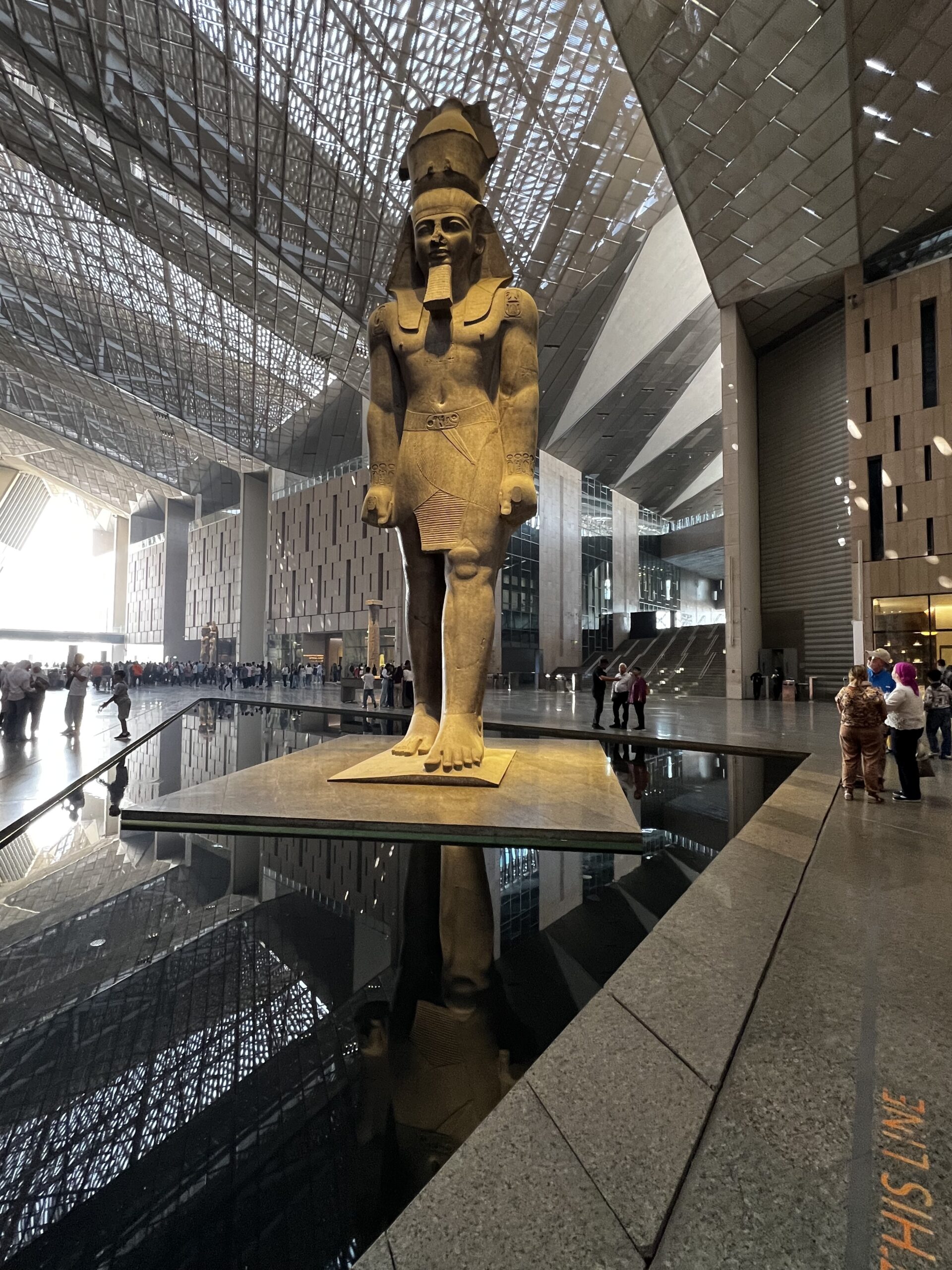
The entrance to the GEM is dominated by a ~36 foot, 83 ton statue of Ramesses II.
The centerpiece of the museum is the complete collection of King Tutankhamun’s 5,398 treasures, displayed together for the first time since Howard Carter discovered the tomb in 1922. While King Tut was himself a minor pharaoh, he and his tomb shot to fame since it was among the few found fully intact having escaped the attention of grave robbers. The golden funerary mask, weighing nearly 25 pounds of solid gold, remains one of the most iconic artifacts in human history (see Figure 8 below). (I have a copy of an original May 1924 National Geographic Magazine in which Maynard Williams describes the opening of the tomb with black and white photos!)

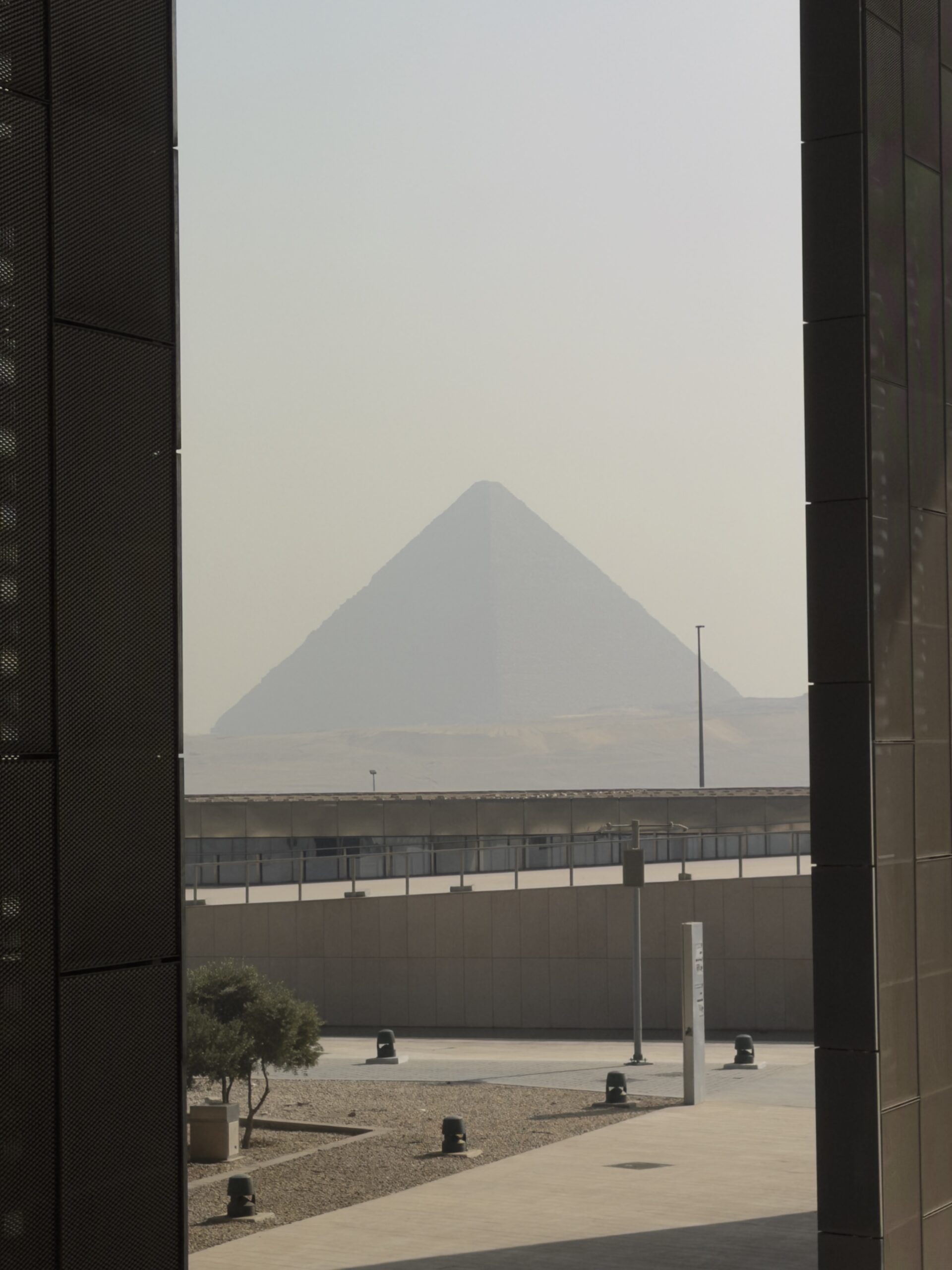
In addition to the view of the pyramids and the shape of the GEM itself, the most dramatic element of the GEM design is the Grand Staircase. Physically, it spans 65,000 sq ft, climbs 160 feet or 6 stories, and connects the main lobby to the window lobby with a stunning view of the Grand Pyramid. It also is a curated journey across 5,000 years of Egyptian history. But, perhaps most importantly, it is symbolic of the journey—as one walks up the stairs—to an afterlife, hopefully in heaven with the Gods!
After six-plus hours exploring the GEM, I emerged mentally and physically exhausted, having witnessed the tangible evidence of one of humanity’s greatest civilizations.
Economic realities and the persistent hustle
With an annual per capita GDP of approximately $3,570 (2024 estimate), the 115M Egyptians are richer than their African brethren. (Comparison: US annual per capita GDP is $90,000 while Tanzania is $1,250, Kenya is $2,500, and India is $2,750). However, the economy struggles despite its rich heritage, strategic location, and low population.
According to World Bank and Egyptian government data, Egypt’s GDP is 51% services (including 8-12% of GDP for tourism), 33% industry (with petroleum/natural gas accounting for ~25%), and 11.6% agriculture. Tourism, despite being relatively small, remains symbolically vital and is heavily promoted.
Five behaviors that hit you every minute
These economic pressures manifest in daily interactions that can be exhausting. During our ten-day visit, five cultural patterns emerged with relentless consistency:
The Baksheesh culture: There’s an expectation of gratuities for doing basic jobs. The focus often shifts from doing good work to securing the tip. You need cash constantly—for drivers, guides, toilet attendants, tomb custodians, temple guards. Exhausting. But, perhaps, telling of an economy where people aren’t paid enough to live a decent life.
Rampant bribery: We watched police officers routinely and blatantly take cash from drivers in broad daylight. When street rumors suggest President Sisi runs a business empire on the side (you see only Kinouz stores—reportedly a Sisi portfolio company—at archaeological sites), complaining feels futile.
Hustling bordering on harassment: Whether store owners or camel drivers, the intensity reaches extreme levels. As an entrepreneur, I respect hustle. But the relentlessness crosses into discomfort.
The price is not the price: There’s an Egyptian price and a foreigner price. Everything is negotiable, which means everything is a game. We were often offered the “brother” price with the refrain: “You look like me. I enjoy Amitabh Bachchan and Shahrukh Khan Bollywood movies. So, I will give you an Indian price.” Youare greeted with a “Namaste” everywhere.
You aren’t playing, if you aren’t bargaining!: Owners name any price they feel like. You’re shadow boxing, visiting multiple stores to test the floor price. On one occasion, Surekha—exercising her Delhi-honed bargaining skills—negotiated from $800 down to $150! Our rule of thumb: aim for 15% of the first ask. Hold your ground. Or simply walk. Exhausting, but necessary.
Mangoes, the people and pleasant surprises
Despite the economic hustle, Egyptians are genuinely friendly and take hospitality seriously—much like India. A ‘no’ is taken personally. They want to help, to please, to make your experience memorable. The chaotic traffic mirrors India’s organized chaos, yet somehow functions.
Our most surprising discovery? Amazing mangoes that give India’s mangoes a run for their money. Who knew?
Mango juice at the Abou Haidar restaurant in Heliopolis was amazing (Thanks, Michael!) Mango tea from Aswan Spices helps Surekha and me get going daily. And, the mango yogurt in the hotels we stayed at supported an incident-free trip.
Walking through time: Reflecting on a paradoxical land
Egypt is a paradox wrapped in 5,000 years of history. It’s a place where architectural precision that predates modern engineering coexists with economic systems that seem designed for inefficiency. Where divine pharaohs who moved mountains of stone gave way to modern leaders struggling to move their economy forward. Where temples that have stood for millennia watch over a society still finding its footing in the 21st century.
Where the ancient Egyptians built for immortality; their modern descendants hustle for daily bread. Both are testaments to human resilience in the face of harsh geography—that narrow ribbon of green surrounded by unforgiving desert.
Yet for all its contradictions and challenges, Egypt delivers on its promise: it assaults your senses, humbles your perspective, and leaves you with a profound appreciation for both human achievement and human resilience. Walking through those temple courtyards, touching stones carved 3,500 years ago, and understanding the astronomical precision of Abu Simbel’s optics teaches you about where we have all come from.
Seeing these artifacts, one realizes that the human impulse to create something greater than ourselves persists. To tell powerful stories of good and bad. And, to use the arts to amplify these stories. Whether it’s a temple that will stand for millennia, a morality story of good fighting bad (Isis and Osiris), a daily negotiation to feed your family, or fighting to build a company, we are all engaged in the same fundamental act—striving against the odds. Irrespective of which ever part of the world we are in.
Perhaps that’s why Egypt reminded me so much of India. And why, despite the chaos on the streets as well as the exhaustion and frustration, I felt oddly at home. The mangoes, I have a hunch, closed the deal!
While National Geographic got me going, there are several wonderful modern day sources of information including the Ancient Egypt website and Wikipedia, books by Nicholas Reeves, Aidan Dodson, Christian Jacq amongst others, and a number of videos on YouTube.com.
A BIG thanks to the Elabd-Hany family for going out of their way to make our trip such a pleasant one!